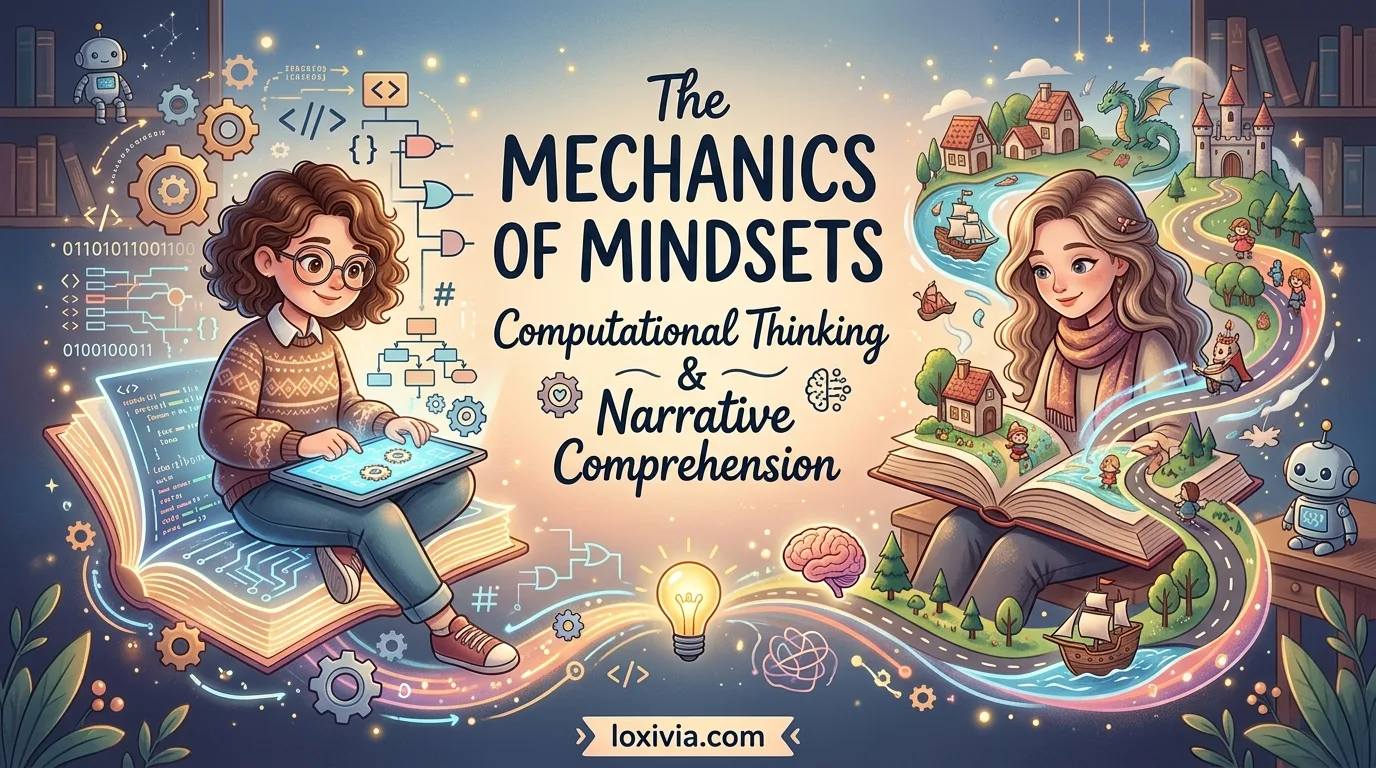
The Mechanics of Mindsets: Computational Thinking and Narrative Comprehension
By Mohamed IDBRAHIM - October 14, 2026 - 4 min read
Introduction
Have you ever wondered how your brain solves a puzzle or follows a story? Computational thinking and narrative comprehension are two powerful ways of thinking that shape how we learn and communicate. In this article, you will learn the English vocabulary to describe these mental processes and use them in natural conversations.
Definition
Computational thinking is a problem-solving approach that involves breaking down complex problems, recognizing patterns, and creating step-by-step solutions. Narrative comprehension is the ability to understand and interpret stories, including their characters, plot, and meaning.
Both terms are often used together because they represent two complementary modes of thought: logical and analytical (computational) versus emotional and interpretive (narrative).
Synonyms and Nuances
| Synonym | Nuance | Register |
|---|---|---|
| Algorithmic thinking | Focuses on step-by-step procedures | Technical |
| Logical reasoning | Emphasizes deduction and inference | Formal |
| Story understanding | Focuses on the meaning of narratives | Neutral |
| Critical analysis | Broad term for evaluating information | Academic |
| Problem decomposition | Specific to breaking down problems | Technical |
Collocations
| Collocation | Example |
|---|---|
| Develop computational thinking | Students develop computational thinking through coding. |
| Enhance narrative comprehension | Reading aloud can enhance narrative comprehension. |
| Apply computational thinking | We apply computational thinking to everyday tasks. |
| Improve narrative skills | Teachers use stories to improve narrative skills. |
| Foster a mindset | Parents can foster a growth mindset in children. |
Example Sentences
- Computational thinking helps programmers design efficient algorithms.
- Narrative comprehension allows readers to empathize with characters.
- By combining computational thinking and narrative comprehension, we can solve problems more creatively.
- Teachers often use computational thinking activities to build logical reasoning.
- Her narrative comprehension improved after she started reading short stories every day.
Common Mistakes
Learners often confuse these terms or use them incorrectly. Here are some common errors:
- Mistake: Using "computational thinking" to mean "computer skills."
Correction: Computational thinking is about problem-solving, not just using computers. - Mistake: Saying "narrative understanding" when you mean "narrative comprehension."
Correction: "Narrative comprehension" is the standard term in education. - Mistake: Mixing up "mindset" with "thinking."
Correction: A mindset is a set of beliefs; thinking is the process of using your mind. - Mistake: Forgetting that these terms are often used in academic contexts.
Correction: Use them in formal writing or discussions about education and psychology.
Word Family
| Noun | Verb | Adjective | Adverb |
|---|---|---|---|
| computation | compute | computational | computationally |
| narrative | narrate | narrative | narratively |
| comprehension | comprehend | comprehensive | comprehensively |
| mindset | set (one's mind) | minded | mindfully |
Mini Practice Quiz
-
What does computational thinking involve?
- A) Using a computer
- B) Breaking down problems
- C) Telling stories
-
Which word is a synonym for narrative comprehension?
- A) Story understanding
- B) Algorithmic thinking
- C) Logical reasoning
-
Complete the collocation: "Teachers use stories to ______ narrative skills."
- A) improve
- B) compute
- C) decompose
Answers: 1. B, 2. A, 3. A
FAQ
Q1: What is the difference between computational thinking and narrative comprehension?
A1: Computational thinking is about logical problem-solving, while narrative comprehension is about understanding stories and emotions.
Q2: Can I use these terms in everyday conversation?
A2: Yes, but they are more common in academic or professional settings. You can simplify them to "problem-solving" and "story understanding" for casual talk.
Q3: How can I improve my narrative comprehension in English?
A3: Read short stories, watch films with subtitles, and practice summarizing plots in your own words.
Visualizing the Relationship
This diagram shows that computational thinking and narrative comprehension are distinct but connected. Together, they form a complete approach to understanding the world.
Conclusion
Mastering the vocabulary of computational thinking and narrative comprehension will help you discuss complex ideas in English. Practice using these terms in your own sentences, and soon they will become part of your active vocabulary.