Prompt Engineering & Logic: How Precision in Language Drives AI Computation
By Mohamed IDBRAHIM - October 15, 2026 - 4 min read
Introduction
When you talk to an AI, your words are not just communication; they are instructions that drive computation. Prompt engineering is the skill of choosing those words carefully so the AI produces exactly what you need. In this article, you will learn the key vocabulary and logic behind precise prompts, and how small changes in language can lead to big differences in results.
Definition
Prompt engineering is the process of designing, refining, and optimizing the text input (the prompt) given to an AI model to achieve a desired output. It combines linguistic precision (clear, unambiguous language) with logical structuring (organizing instructions step by step). Logic here refers to the reasoning rules that guide how the AI interprets your request. In short, prompt engineering is about using language as a precise tool to control computation.
Synonyms and Nuances
| Synonym | Nuance | Register |
|---|---|---|
| Instruction design | Focuses on the structure of commands | Formal, technical |
| Query crafting | Emphasizes the question or request | Neutral, common in tech |
| Input tuning | Suggests adjusting parameters | Technical, slightly informal |
| AI whispering | Informal, implies skill and intuition | Informal, colloquial |
| Prompt writing | Simple, general term | Neutral, everyday |
Collocations
| Collocation | Meaning | Example |
|---|---|---|
| craft a prompt | Create a prompt carefully | She crafted a prompt to get a detailed answer. |
| refine a prompt | Improve a prompt step by step | He refined his prompt until the output was perfect. |
| precise language | Exact and clear wording | Precise language reduces confusion. |
| logical structure | Organized reasoning | A logical structure helps the AI follow your steps. |
| drive computation | Cause the computer to process | Your words drive the computation inside the model. |
| ambiguous instruction | Unclear command | An ambiguous instruction leads to unpredictable results. |
Five Natural Example Sentences
- Prompt engineering requires you to think like a programmer and a writer at the same time.
- If you want a step-by-step answer, you should use logical connectors like "first," "then," and "finally."
- The AI's output changed dramatically when I replaced vague words with precise terms.
- Ambiguous prompts often cause the model to guess, which can lead to errors.
- By refining the prompt, she turned a confusing request into a clear computation.
Common Mistakes
- Being too vague: Saying "Tell me about dogs" is less effective than "List three unique characteristics of Border Collies."
- Using ambiguous pronouns: "It" and "they" can confuse the AI. Repeat the noun instead.
- Forgetting to specify format: If you want a table, say "in a table." If you want a list, say "as a bullet list."
- Mixing multiple tasks: Asking for a summary and a translation in one sentence can split the AI's focus. Use separate prompts or clear sections.
- Ignoring logic words: Words like "because," "therefore," and "however" guide the AI's reasoning. Use them deliberately.
Word Family
| Noun | Verb | Adjective | Adverb |
|---|---|---|---|
| prompt | prompt | prompt | promptly |
| engineering | engineer | engineered | engineeredly (rare) |
| logic | logicize (rare) | logical | logically |
| precision | precise (verb form rare) | precise | precisely |
Mini Practice Quiz
1. Which word means "clear and exact"?
A) Ambiguous
B) Precise
C) Vague
D) Logical
2. What is the best way to ask an AI for a list?
A) "Tell me about fruits."
B) "List five fruits in a bullet list."
C) "Fruits?"
D) "I like fruits."
3. Fill in the blank: A good prompt uses ______ language to avoid confusion.
A) ambiguous
B) precise
C) emotional
D) random
Answers:
- B) Precise
- B) "List five fruits in a bullet list."
- B) precise
FAQ
Q1: Is prompt engineering only for programmers?
No. Anyone who uses AI can benefit from clear, logical prompts. It is a communication skill.
Q2: How can I make my prompts more logical?
Use sequence words (first, next, finally) and cause-effect words (because, therefore). Break complex tasks into smaller steps.
Q3: What is the biggest mistake in prompt engineering?
Being too vague. Always specify what you want, how you want it, and in what format.
Visualizing the Logic of a Prompt
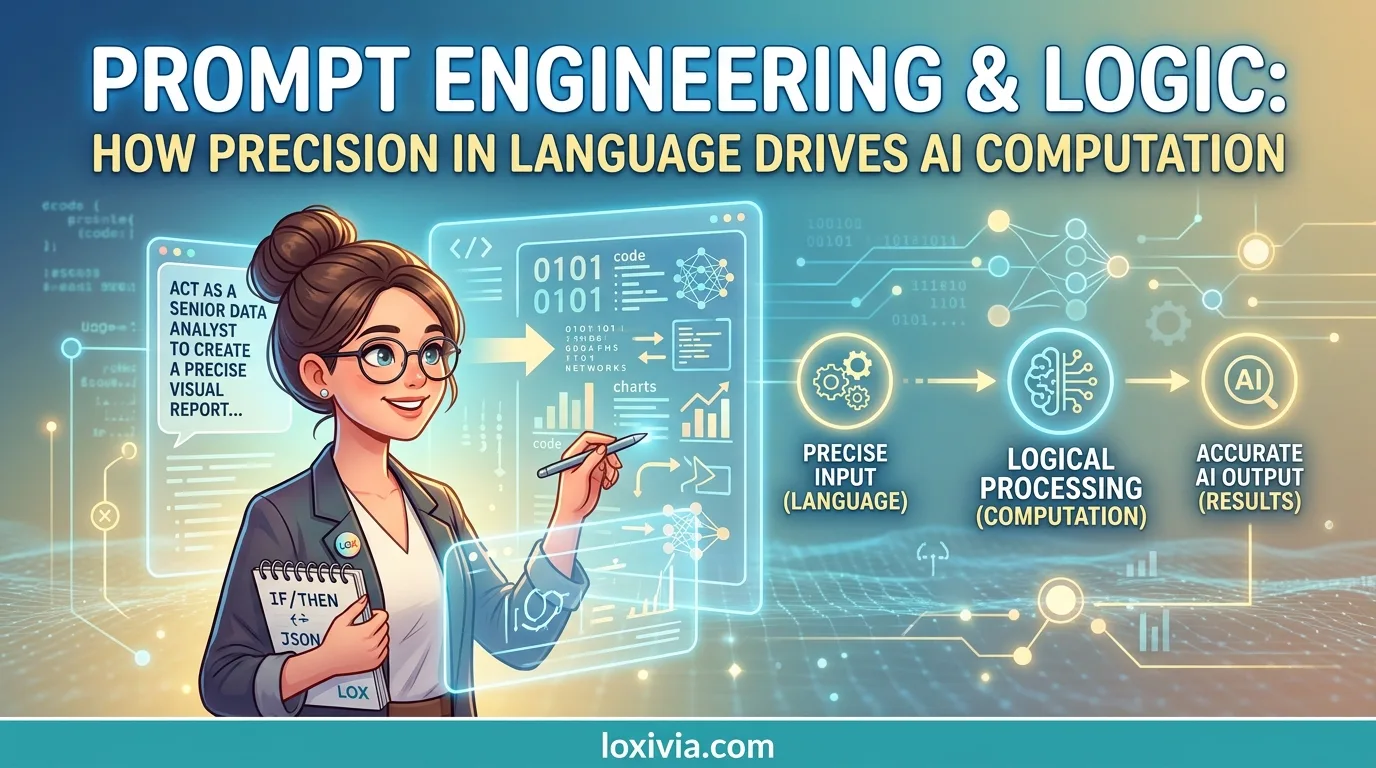
In this diagram, the prompt (your words) enters a logic stage (the AI's reasoning) and results in an output (the answer). Precision at the start improves the final result.
Conclusion
Prompt engineering is not magic; it is a skill built on precise language and logical thinking. By choosing your words carefully and structuring your requests, you can drive AI computation to work for you. Practice with the examples and quiz above, and you will see immediate improvements in your AI interactions.