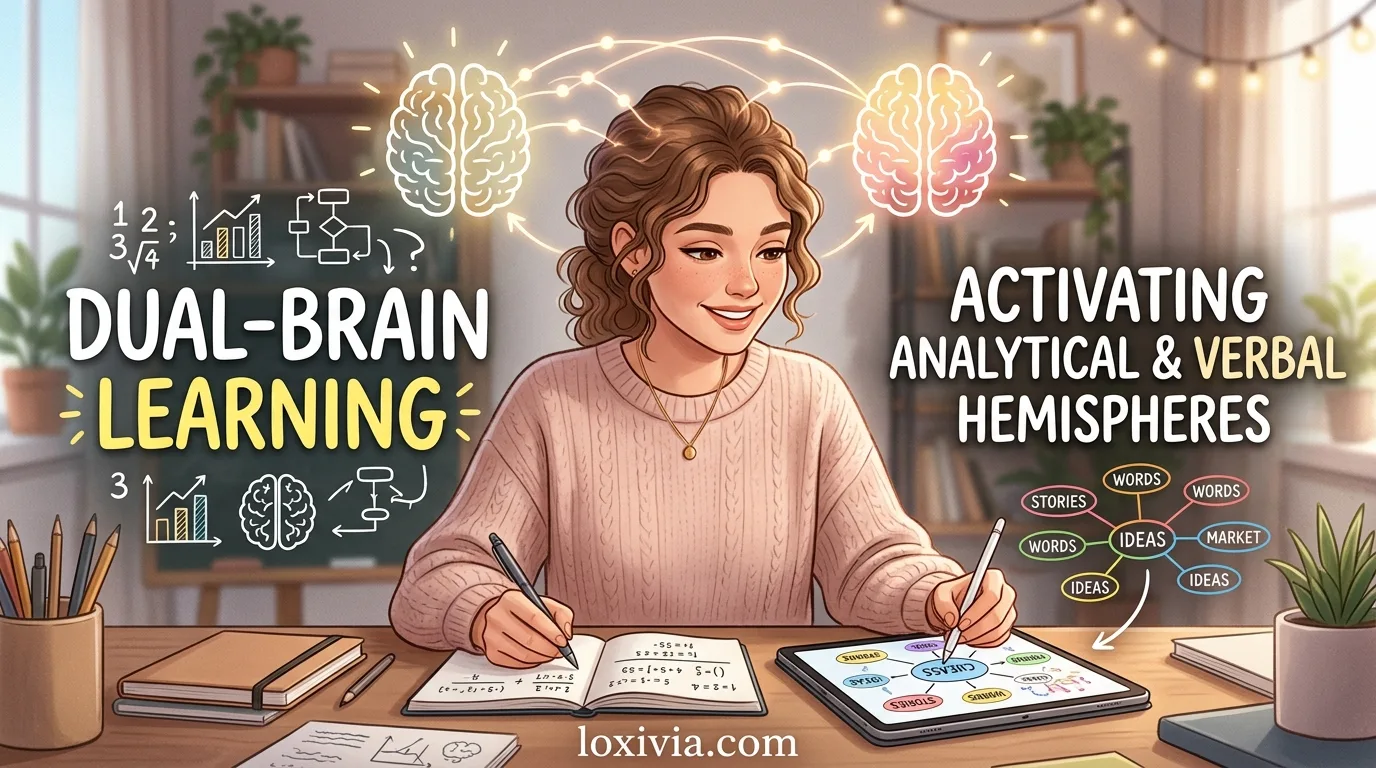
Dual-Brain Learning: Activating Analytical and Verbal Hemispheres
By Mohamed IDBRAHIM - October 13, 2026 - 6 min read
Introduction
Have you ever tried to solve a math problem while explaining it out loud? That simple act uses dual-brain learning, a phrase that describes engaging both the analytical and verbal sides of your brain. In this article, you will learn what dual-brain learning means, how to use it naturally in English, and how to avoid common mistakes.
Definition
Dual-brain learning is a learning approach that deliberately activates two complementary cognitive systems: the analytical hemisphere (often associated with logic, patterns, and numbers) and the verbal hemisphere (often associated with language, storytelling, and explanation). The term is not a strict medical diagnosis; it is a practical metaphor for combining two modes of thinking to improve understanding and memory.
In everyday English, you can use dual-brain learning as a noun phrase. It often appears in education, psychology, and self-improvement contexts. For example:
- Dual-brain learning helped me understand calculus by talking through each step.
- Teachers use dual-brain learning to connect formulas with real-life stories.
Synonyms and Nuances
The following table shows words and phrases that are close in meaning to dual-brain learning, along with their nuance and register.
| Synonym | Nuance | Register |
|---|---|---|
| Whole-brain learning | Emphasizes using many brain functions together, not just two. | Neutral / educational |
| Multimodal learning | Focuses on using different senses and media (text, audio, visuals). | Academic / technical |
| Integrated learning | Stresses combining subjects or skills into one coherent experience. | Formal / educational |
| Cross-hemispheric learning | More scientific-sounding; refers to communication between brain hemispheres. | Technical / psychology |
| Balanced learning | Broad and simple; suggests equal attention to different skills. | Neutral / everyday |
Common Collocations
Collocations are words that naturally go together. Here are common partners for dual-brain learning and related terms.
| Collocation | Example |
|---|---|
| activate dual-brain learning | You can activate dual-brain learning by drawing a diagram and describing it. |
| promote dual-brain learning | The workshop promotes dual-brain learning through group discussions. |
| apply dual-brain learning | She applies dual-brain learning when she studies chemistry. |
| dual-brain learning strategy | A dual-brain learning strategy combines writing and speaking. |
| dual-brain learning approach | Their dual-brain learning approach uses both logic puzzles and debates. |
| benefits of dual-brain learning | The benefits of dual-brain learning include better retention. |
Five Natural Example Sentences
- When I explain a graph in my own words, I am using dual-brain learning to connect numbers with language.
- Many teachers believe that dual-brain learning helps students remember abstract ideas for longer.
- He struggled with coding until he started dual-brain learning: writing code and then describing each line aloud.
- The article describes dual-brain learning as a bridge between analytical thinking and verbal expression.
- If you want to improve your English, try dual-brain learning by solving logic puzzles and then discussing your answers.
Common Mistakes
Learners often make small errors with this phrase. Here are the most frequent ones.
- Mistake 1: Using a hyphen incorrectly. The standard form is dual-brain learning (hyphen between dual and brain). Do not write dual brain learning when it acts as a compound adjective before a noun.
- Mistake 2: Confusing it with a medical condition. Dual-brain learning is not a diagnosis. It is a learning strategy.
- Mistake 3: Saying the dual-brain learning when speaking generally. Use it without the when you mean the concept in general: Dual-brain learning is useful. Not The dual-brain learning is useful.
- Mistake 4: Overusing it as a verb. You cannot dual-brain learn. Say use dual-brain learning or apply dual-brain learning.
- Mistake 5: Forgetting the plural form. If you talk about multiple strategies, you can say dual-brain learning strategies.
Word Family
| Part of Speech | Word | Example |
|---|---|---|
| Noun | dual-brain learning | Dual-brain learning improves memory. |
| Verb | activate (related verb) | You can activate both hemispheres. |
| Adjective | dual-brain | She uses a dual-brain approach. |
| Adverb | dual-brain-friendly (informal) | He studied dual-brain-friendly. |
Note: Dual-brain learning does not have a direct verb form. Use activate, apply, or use with the noun.
Mini Practice Quiz
Choose the best answer for each question.
-
Which sentence uses dual-brain learning correctly? a) I dual-brain learn every day. b) Dual-brain learning helps me connect ideas. c) The dual-brain learning is a brain part.
-
What is a good synonym for dual-brain learning in an academic text? a) Multimodal learning b) Sleeping c) Single-task learning
-
Fill in the blank: You can ______ dual-brain learning by drawing and explaining. a) do b) activate c) make
Answers: 1. b, 2. a, 3. b
FAQ
Q1: Is dual-brain learning a real scientific term? It is more of a popular and educational phrase than a strict scientific term. Neuroscientists study hemispheric differences, but dual-brain learning is a practical label for combining analytical and verbal tasks.
Q2: Can I use dual-brain learning in everyday conversation? Yes. It sounds a bit formal, but you can say, I use dual-brain learning when I study in everyday English. For a more casual tone, say I use both sides of my brain.
Q3: How can I practice dual-brain learning as an English learner? Try this routine: solve a simple math problem, then explain your steps in English out loud. Or read a short article, then summarize it in writing. Both activities connect analytical and verbal skills.
Visual Summary
The diagram below shows how dual-brain learning connects two modes of thinking.
To read the diagram: the left box represents analytical tasks, the right box represents verbal tasks, and the arrow shows that dual-brain learning links them together.
Code Example
If you are learning to code, you can practice dual-brain learning by writing a simple function and then explaining it in a comment.
# Dual-brain learning: write code and explain it in words
def add_numbers(a, b):
    """Return the sum of a and b."""
    return a + b

# Now explain: This function takes two numbers and adds them.
Math Example
You can also use dual-brain learning in math by solving an equation and then describing each step.
$$\frac{d}{dx}(x^2 + 3x) = 2x + 3$$
Explain in words: The derivative of x squared is 2x, and the derivative of 3x is 3, so the result is 2x plus 3. This combines analytical calculation with verbal explanation.
Final Tips
- Use dual-brain learning as a noun phrase.
- Pair it with verbs like activate, apply, promote, and use.
- Remember the hyphen: dual-brain learning.
- Practice by explaining your analytical work out loud in English.
With regular practice, you will use this phrase naturally and improve both your English and your thinking skills.