The Earth's Atmosphere & Properties of Air: English for Science and Everyday Life
By Mohamed IDBRAHIM - September 27, 2026 - 5 min read
Introduction
The air around us is easy to ignore, but it is one of the most important systems on Earth. In this lesson, you will learn the English words and phrases we use to describe the Earth's atmosphere and the properties of air. By the end, you will be able to talk about weather, climate, and basic science in clear, natural English.
Definition
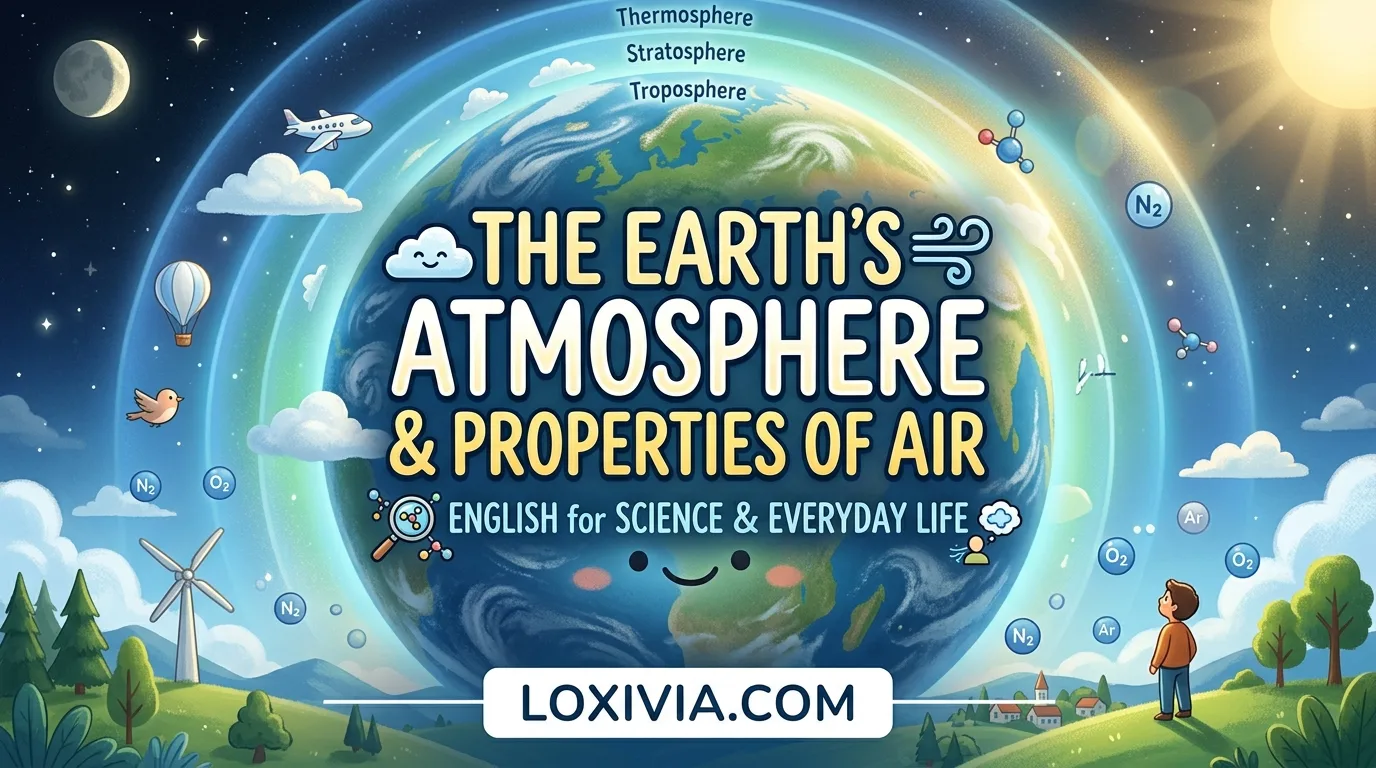
The Earth's atmosphere is the layer of gases that surrounds the planet and is held in place by gravity. It is made mostly of nitrogen (about 78%) and oxygen (about 21%), with small amounts of argon, carbon dioxide, and other gases. The atmosphere protects life by absorbing harmful radiation, reducing temperature extremes, and allowing us to breathe.
Properties of air are the characteristics we can observe or measure, such as temperature, pressure, density, humidity, and movement (wind). Air is a mixture, not a single substance, so its properties can change from place to place and from moment to moment.
Synonyms and Related Terms
| Term | Nuance | Register |
|---|---|---|
| atmosphere | The whole layer of gases around a planet. | Neutral / scientific |
| air | The mixture of gases we breathe; more everyday. | Common / neutral |
| the sky | What we see above us; not a scientific term. | Informal / poetic |
| aerosphere | A rare, technical word for the atmosphere. | Very formal / technical |
| ambient air | The air in a particular place, especially outdoors. | Technical / environmental |
| climate system | The atmosphere plus oceans, land, and ice working together. | Scientific / academic |
Collocations
| Collocation | Meaning | Example |
|---|---|---|
| air pressure | The force of air pushing on a surface. | Air pressure drops before a storm. |
| air quality | How clean or polluted the air is. | The city has poor air quality in winter. |
| greenhouse gas | A gas that traps heat in the atmosphere. | Carbon dioxide is a greenhouse gas. |
| ozone layer | A part of the atmosphere that blocks UV rays. | The ozone layer is slowly recovering. |
| air current | A moving stream of air. | Birds use air currents to fly higher. |
| atmospheric pressure | The same as air pressure, but more formal. | Atmospheric pressure is lower at high altitude. |
| breathe in / breathe out | To take air into or out of your lungs. | Breathe in slowly, then breathe out. |
Example Sentences
- The Earth's atmosphere is made up of several layers, including the troposphere and the stratosphere.
- Air pressure is higher at sea level than on top of a mountain.
- When the humidity is high, the air feels heavy and sticky.
- Scientists measure air quality to check for pollution in cities.
- Warm air rises because it is less dense than cold air, which creates wind.
A Simple Diagram of the Atmosphere
This diagram shows the main layers of the atmosphere, starting with the troposphere where most weather happens, and going up to the exosphere at the edge of space.
Common Mistakes
- Mixing up "weather" and "climate": Weather is what happens day to day. Climate is the average pattern over many years.
- Saying "air is made of oxygen": Air is a mixture of gases. Oxygen is only about 21% of it.
- Using "atmosphere" for a room: For a room, use air or ventilation, not atmosphere.
- Confusing "pressure" and "temperature": Pressure is force per area. Temperature is how hot or cold something is.
- Forgetting that air has weight: Air is matter, so it has mass and takes up space.
Word Family
| Noun | Verb | Adjective | Adverb |
|---|---|---|---|
| atmosphere | (rare) atmospherize | atmospheric | atmospherically |
| air | aerate | airy | airily |
| pressure | pressurize | pressurized | pressingly |
| density | densify | dense | densely |
| humidity | humidify | humid | humidly |
Mini Practice Quiz
- What gas makes up most of the Earth's atmosphere?
- True or false: Warm air is denser than cold air.
- Complete the sentence: "The ozone layer is found in the ________."
- Which word means "the force of air pushing on a surface"?
- Give one example of a greenhouse gas.
Answers
- Nitrogen (about 78%).
- False. Warm air is less dense than cold air.
- Stratosphere.
- Air pressure (or atmospheric pressure).
- Carbon dioxide (or methane, water vapor, etc.).
FAQ
Q1: What is the difference between "air" and "atmosphere"? A: Air is the mixture of gases we breathe. Atmosphere is the whole layer of gases around a planet, including all its layers.
Q2: How can I remember the layers of the atmosphere? A: Use the order from bottom to top: Troposphere, Stratosphere, Mesosphere, Thermosphere, Exosphere. A common memory trick is "The Stupid Monkey Tries Exercises."
Q3: Why does air pressure decrease as you go higher? A: Because there is less air above you pushing down. At high altitude, the air is thinner, so air pressure is lower.
Quick Code Example
If you want to calculate air pressure at a given altitude, you can use a simple formula in Python:
# Estimate air pressure at altitude h (in meters)
# Using a simplified barometric formula
import math

def air_pressure(h):
    P0 = 101325  # sea level pressure in Pascals
    T0 = 288.15  # sea level temperature in Kelvin
    L = 0.0065   # temperature lapse rate in K/m
    g = 9.80665  # gravity in m/s^2
    M = 0.0289644  # molar mass of air in kg/mol
    R = 8.3144598  # gas constant
    return P0 * (1 - (L * h) / T0) ** (g * M / (R * L))

print(air_pressure(1000))  # about 89875 Pa
This code shows how pressure changes with height, which is a key property of air.
Conclusion
Understanding the Earth's atmosphere and the properties of air helps you talk about science, weather, and the environment in English. Practice the words and collocations from this lesson, and try to use them when you read news about climate or watch a weather report.