Cryptology & Linguistics: Decoding Secrets Through Language and Probability
By Mohamed IDBRAHIM - October 14, 2026 - 5 min read
Introduction
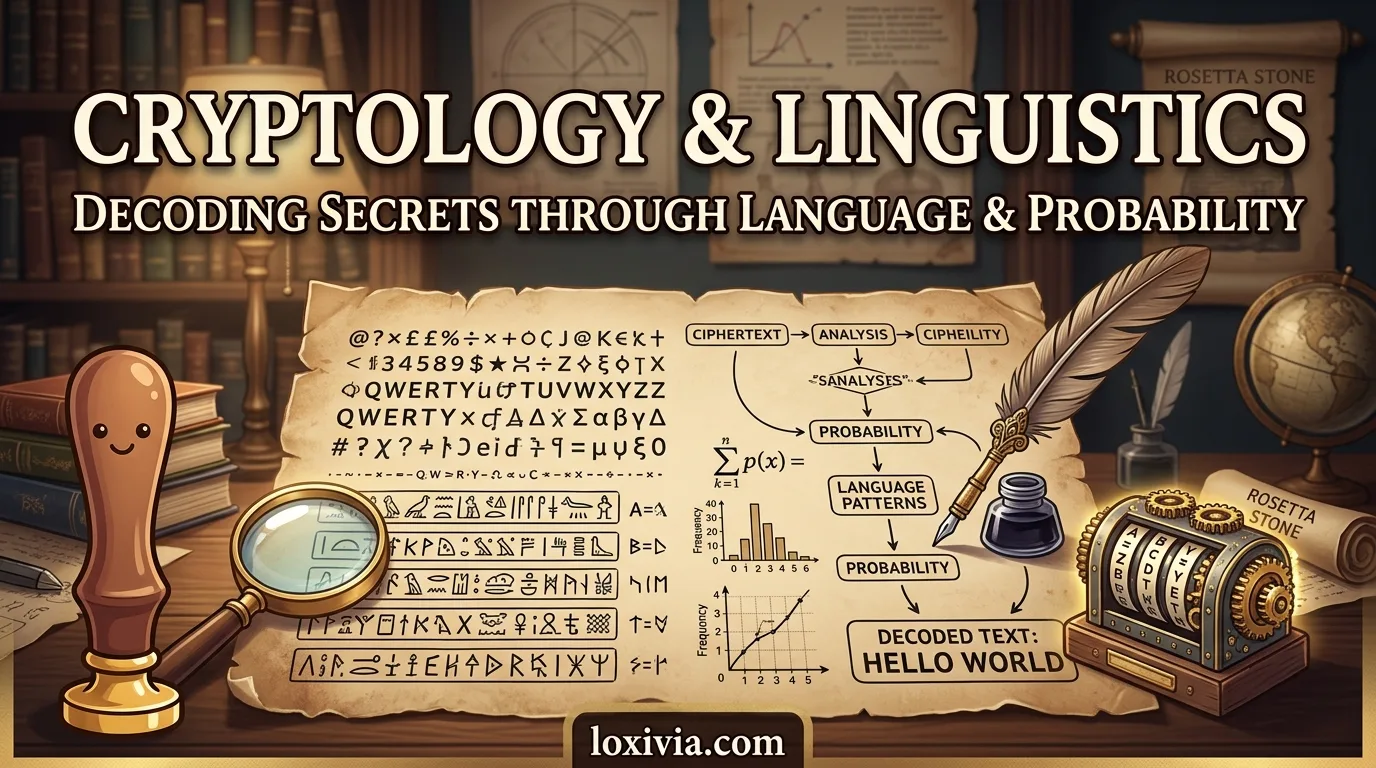
Cryptology is the study of secret communication. It combines cryptography (making codes) and cryptanalysis (breaking codes). Linguistics is the study of language. When you put them together, you use language patterns and probability to decode secrets. This article will help you understand the key vocabulary and ideas.
Definition
Cryptology (noun) is the science of writing and solving secret messages. It comes from Greek: kryptos (hidden) and logos (word). Linguistics (noun) is the scientific study of language, including sounds, words, and grammar. Together, they help us decode (verb) messages by looking at how often letters or words appear. For example, in English, the letter E is the most common. In a secret message, if one symbol appears very often, it might stand for E. This is a simple frequency analysis.
Probability (noun) helps us guess which letter or word is most likely. For instance, if you see the pattern "_he", the missing letter is probably t to make "the". So, cryptology and linguistics use math and language together.
Synonyms and Nuances
Here are words related to cryptology and linguistics. Pay attention to their nuance (small difference in meaning) and register (formal or informal).
| Synonym | Nuance | Register |
|---|---|---|
| Cryptography | The practice of making codes. Focus on creation. | Formal, technical |
| Cryptanalysis | The practice of breaking codes. Focus on solving. | Formal, technical |
| Decipher | To convert a coded message into normal language. Often used for ancient texts. | Neutral, common |
| Decode | To convert a coded message. More general than decipher. | Neutral, common |
| Decrypt | To convert encrypted data back to original. Used in computing. | Technical, computing |
| Linguistic | Related to language. Adjective. | Formal, academic |
Collocations
Collocations are words that often go together. Here are common ones with cryptology and linguistics.
| Collocation | Example |
|---|---|
| break a code | The team worked all night to break the code. |
| crack a cipher | She cracked the cipher using frequency analysis. |
| decode a message | Can you decode this message for me? |
| linguistic analysis | Linguistic analysis revealed the author's dialect. |
| probability distribution | The probability distribution of letters helped us guess. |
| secret key | Without the secret key, the message stays locked. |
Five Natural Example Sentences
- Cryptology and linguistics together helped us understand the ancient script.
- The spy used a simple cipher to hide the message.
- By counting letter frequencies, we decoded the secret note.
- Probability tells us that the letter E is most common in English.
- Her linguistic skills made her an excellent cryptanalyst.
Common Mistakes
Learners often confuse these terms. Avoid these errors:
- Mistake 1: Using cryptology and cryptography as synonyms. Cryptology is the whole field. Cryptography is only making codes.
- Mistake 2: Saying decipher for computer data. Use decrypt for digital data.
- Mistake 3: Forgetting that linguistics is not just grammar. It includes sounds, meaning, and social use.
- Mistake 4: Thinking probability is only for math. It is also for language guessing.
- Mistake 5: Pronouncing cryptology as "cry-ptology". Say "crip-TOL-uh-jee".
Word Family
| Noun | Verb | Adjective | Adverb |
|---|---|---|---|
| cryptology | decode | cryptographic | cryptically |
| linguistics | analyze | linguistic | linguistically |
| probability | calculate | probable | probably |
Mini Practice Quiz
Try these questions. Then check your answers below.
- What is the difference between cryptography and cryptanalysis?
- Which letter is most common in English?
- What word means "to convert a coded message into normal language"?
- True or false: Linguistics only studies grammar.
- What is the adverb form of linguistic?
Answers:
- Cryptography is making codes; cryptanalysis is breaking codes.
- The letter E.
- Decipher (or decode).
- False. It studies sounds, words, meaning, and more.
- Linguistically.
FAQ
Q1: Is cryptology only for spies? No. It is used in computer security, banking, and even in language research.
Q2: How does probability help in decoding? Probability tells us which letters or words are likely. For example, in English, E appears about 12% of the time. So if a symbol appears often, it might be E.
Q3: Can I learn cryptology without math? You can start with simple puzzles. But basic math, like counting and percentages, helps a lot. Linguistics also helps because you look at language patterns.
Visualizing Frequency Analysis
Here is a simple diagram showing how often letters appear in English. The taller the bar, the more common the letter.
You can use this to guess letters in a simple substitution cipher.
Using Math in Cryptology
Probability is written with math. For example, the probability of a letter is:
$$P(\text{letter}) = \frac{\text{count of letter}}{\text{total letters}}$$
If a message has 100 letters and 12 are E, then (P(E) = 12/100 = 0.12). This helps you compare symbols.
Conclusion
Cryptology and linguistics are a powerful pair. By understanding language patterns and using probability, you can decode secret messages. Practice with simple ciphers and pay attention to common letters. Soon, you will be a better codebreaker and a smarter language learner.