The Grammar of Geometry: Where Lines and Language Connect
By Mohamed IDBRAHIM - October 3, 2026 - 5 min read
Introduction
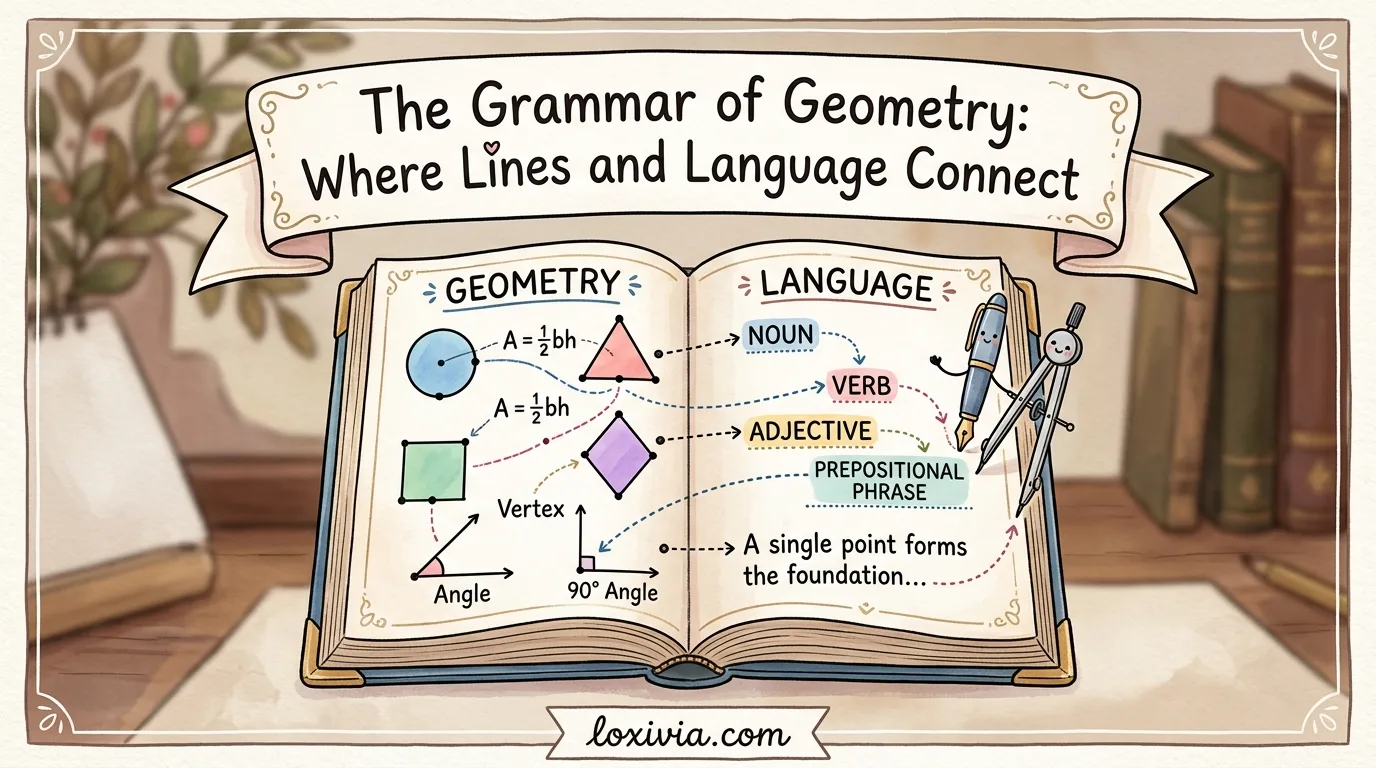
Geometry is more than just shapes and numbers. It is a language of its own, full of precise words like parallel, perpendicular, and intersect. When you learn English, understanding these terms helps you describe the world around you, from the layout of a city to the design of a website. In this article, we will connect the dots between geometry and English so you can speak and write about spatial relationships clearly.
Definition
Geometry (noun) is the branch of mathematics that deals with points, lines, angles, surfaces, and solids. In everyday English, we also use geometric terms metaphorically. For example, parallel lines never meet, which can describe two people or ideas that are similar but never connected. Perpendicular means meeting at a 90-degree angle. Intersect means to cross or divide by passing through. Understanding these words helps you follow directions, read graphs, and even solve puzzles.
Synonyms and Nuances
Geometry has a precise vocabulary, but some words have near-synonyms with different shades of meaning and formality. The table below shows common alternatives.
| Synonym | Nuance | Register |
|---|---|---|
| Parallel | Lines that are always the same distance apart and never meet. | Formal / Technical |
| Equidistant | Points that are the same distance from a given point or line. | Formal / Academic |
| Perpendicular | Lines that meet at a right angle (90 degrees). | Formal / Technical |
| Orthogonal | A more technical term for perpendicular, often used in mathematics and engineering. | Very Formal / Technical |
| Intersect | To cross or meet at a point. | Neutral / General |
| Cross | A simpler, everyday word for intersect. | Informal / General |
| Tangent | A line that touches a curve at exactly one point without crossing it. | Formal / Technical |
Collocations
Certain words frequently appear together with geometric terms. Learning these collocations will make your English sound more natural.
| Collocation | Example |
|---|---|
| Draw a line | Please draw a straight line from point A to point B. |
| Measure an angle | Use a protractor to measure the angle. |
| Parallel lines | The two roads run as parallel lines for five miles. |
| Right angle | The corner of a square forms a right angle. |
| Intersect at a point | The two circles intersect at two points. |
| Tangent to a curve | The line is tangent to the circle at point P. |
| Geometric shape | A triangle is a basic geometric shape. |
Example Sentences
- The architect designed the building with parallel lines to create a sense of order.
- In a right triangle, the two shorter sides are perpendicular to each other.
- The graphs of the two equations intersect at exactly one point.
- A tangent line touches the circle at only one point and does not cross it.
- The streets in the old town are not parallel; they curve and meet at odd angles.
Common Mistakes
Learners often confuse geometric terms or use them incorrectly. Here are some frequent errors and how to avoid them.
- Confusing parallel and perpendicular: Parallel lines never meet; perpendicular lines meet at 90 degrees. Remember: parallel = same direction, perpendicular = right angle.
- Using "cross" instead of "intersect" in formal writing: In academic contexts, prefer intersect. "Cross" is fine in everyday speech.
- Saying "a tangent line crosses the circle": A tangent line touches the circle at exactly one point. It does not cross it.
- Mixing up "angle" and "corner": An angle is the space between two intersecting lines. A corner is the point where two edges meet. They are related but not the same.
- Forgetting that "geometry" is uncountable: We say "Geometry is interesting," not "A geometry is interesting."
Word Family
| Noun | Verb | Adjective | Adverb |
|---|---|---|---|
| Geometry | Geometrize | Geometric | Geometrically |
| Parallel | Parallelize | Parallel | Parallelly (rare) |
| Perpendicular | Perpendicularize (rare) | Perpendicular | Perpendicularly |
| Intersection | Intersect | Intersecting | Intersectingly (rare) |
Mini Practice Quiz
Test your understanding with these questions.
- What do we call two lines that never meet and are always the same distance apart?
- Which word means "to cross or meet at a point"?
- Is a tangent line crossing a circle? Explain.
- Fill in the blank: The two sides of a square are ______ to each other.
- True or false: "Geometry" is a countable noun.
Answers:
- Parallel lines.
- Intersect.
- No, a tangent line touches the circle at exactly one point and does not cross it.
- Perpendicular.
- False. "Geometry" is uncountable.
FAQ
Q1: What is the difference between "parallel" and "perpendicular"? A: Parallel lines run in the same direction and never meet. Perpendicular lines meet at a 90-degree angle.
Q2: Can I use "cross" instead of "intersect"? A: Yes, in informal English. But in technical or academic writing, intersect is more precise.
Q3: How can I remember geometric terms easily? A: Draw diagrams and label them. Visual memory helps. Also, practice using the words in sentences about everyday objects like roads, buildings, and furniture.
Visual Aid: Parallel and Perpendicular Lines
This diagram shows two parallel lines that never meet, and below them, two perpendicular lines that intersect at a 90-degree angle.
Mathematical Notation
In geometry, we often use symbols and equations. For example, the equation of a line in slope-intercept form is:
$$ y = mx + b $$
Here, ( m ) is the slope and ( b ) is the y-intercept. Two lines are parallel if their slopes are equal: ( m_1 = m_2 ). They are perpendicular if the product of their slopes is -1: ( m_1 \cdot m_2 = -1 ).
You can also represent a line in code, for example in Python:
def is_parallel(m1, m2):
    return m1 == m2

def is_perpendicular(m1, m2):
    return m1 * m2 == -1
This code checks if two lines are parallel or perpendicular based on their slopes.
Conclusion
Geometry and English are deeply connected. By learning the precise terms and their collocations, you can describe shapes, lines, and angles with confidence. Practice with the quiz, draw your own diagrams, and soon the language of geometry will feel as natural as drawing a straight line.