Understanding Connected Speech: Why Native Speakers Sound So Fast
By Loxivia - September 23, 2026 - 5 min read
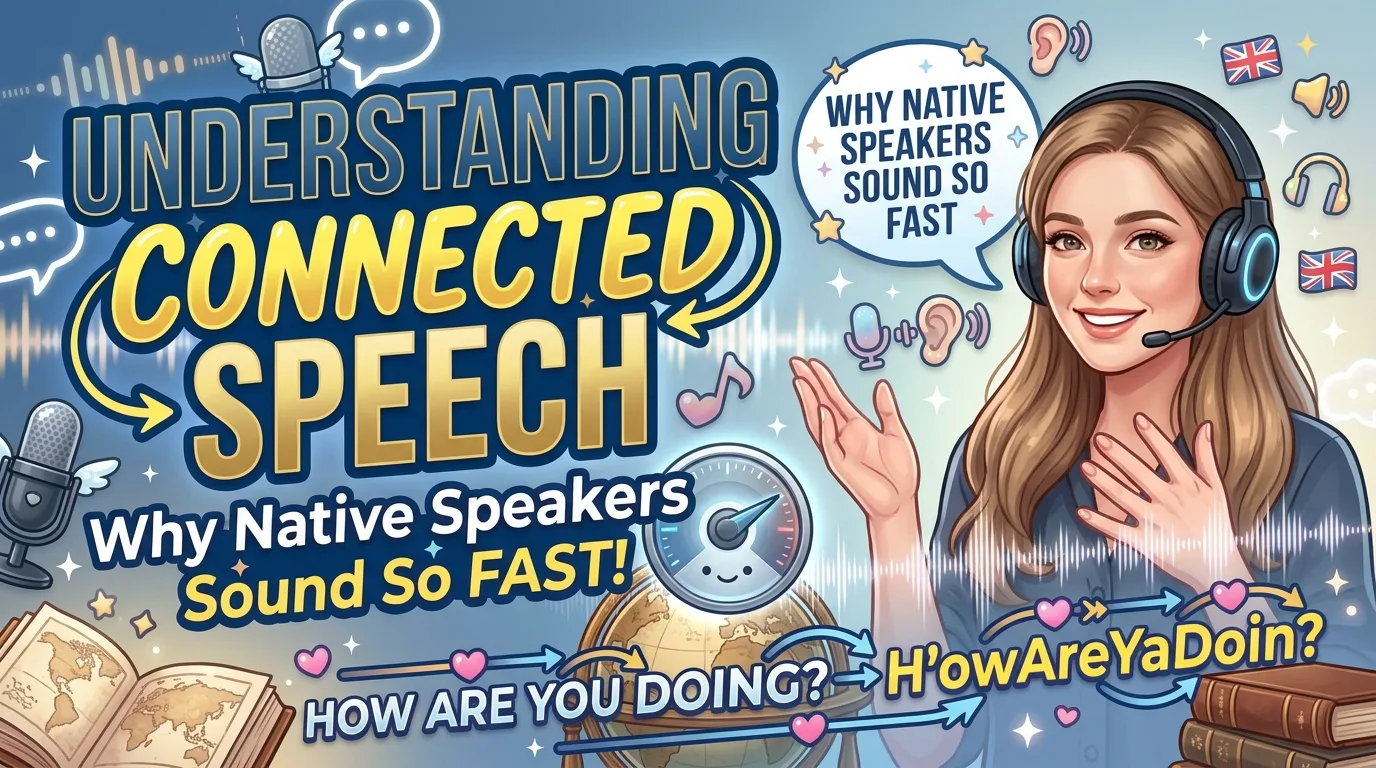
Have you ever listened to a native English speaker and felt like they were speaking a completely different language? You are not alone. The secret is not that they speak faster than you can think; it is that they connect words together in ways that your textbook probably did not teach you. This article will help you understand connected speech, so you can finally hear the words inside the stream of sound.
Definition
Connected speech (also called linking or sandhi) is the way native speakers pronounce words in a continuous flow, rather than separating each word clearly. When we speak naturally, we link the final sound of one word to the first sound of the next, reduce unstressed vowels, and sometimes change sounds to make them easier to say. This is why "What are you doing?" can sound like "Whaddaya doin'?" and why "an apple" sounds like "a napple".
Connected speech is not lazy or incorrect; it is a natural feature of fluent English. Understanding it is the key to improving your listening comprehension and sounding more natural when you speak.
Synonyms and Related Terms
| Term | Nuance | Register |
|---|---|---|
| Linking | Specifically joining the end of one word to the start of the next (e.g., "turn it off" → "tur-ni-toff"). | Neutral / technical |
| Reduction | Weakening or changing vowels in unstressed syllables (e.g., "and" → /ən/). | Neutral / technical |
| Assimilation | When a sound changes to become more like a neighboring sound (e.g., "don't you" → "doncha"). | Neutral / technical |
| Elision | Dropping a sound entirely (e.g., "next day" → "nex' day"). | Neutral / technical |
| Coarticulation | The overlapping of articulatory movements in speech. | Formal / academic |
Common Collocations
| Collocation | Example |
|---|---|
| connected speech | "Connected speech is difficult for learners to understand." |
| natural speech | "In natural speech, words often blend together." |
| fast speech | "Fast speech contains many reductions." |
| linking sounds | "Linking sounds help words flow smoothly." |
| reduce vowels | "Speakers reduce vowels in unstressed syllables." |
| blend words | "English speakers blend words together in conversation." |
Five Natural Example Sentences
- "What do you want to do?" → In connected speech: "Whaddaya wanna do?"
- "I have to go to the store." → "I hafta go to the store."
- "Did you eat yet?" → "Dja eat yet?"
- "Let me help you." → "Lemme help ya."
- "Give it to him." → "Giv-it-to-im."
Notice how the words link together and some sounds change or disappear. This is connected speech in action.
Common Mistakes
Learners often make these mistakes when trying to understand or produce connected speech:
- Pronouncing every word separately. This makes speech sound choppy and can confuse listeners. In natural speech, words flow together.
- Expecting to hear all sounds clearly. Many sounds are reduced or dropped. For example, "probably" often becomes "probly".
- Thinking connected speech is slang. It is a standard feature of all spoken English, from casual to formal.
- Overusing reductions in writing. Connected speech is for speaking and informal writing (like text messages), not for formal essays.
- Not practicing listening enough. You need to train your ear with real conversations, podcasts, and movies.
Word Family
| Noun | Verb | Adjective | Adverb |
|---|---|---|---|
| connection | connect | connected | connectedly |
| speech | speak | spoken | speakably |
| reduction | reduce | reduced | reducedly |
| assimilation | assimilate | assimilated | assimilatively |
Mini Practice Quiz
Test your understanding of connected speech. Choose the correct answer.
-
What is connected speech?
- a) Speaking very fast
- b) Linking and reducing sounds in natural speech
- c) Using slang words
-
Which of these is an example of reduction?
- a) "I am" → "I'm"
- b) "I am" → "I am"
- c) "I am" → "I are"
-
What does "whaddaya" mean in connected speech?
- a) What are you
- b) What do you
- c) Where are you
Answers:
- b) Linking and reducing sounds in natural speech
- a) "I am" → "I'm"
- b) What do you
FAQ
Q1: Is connected speech only for fast speech? No, connected speech occurs at all speeds. Even slow, careful speech has some linking and reduction.
Q2: Will learning connected speech help me speak better? Yes. Understanding it improves your listening, and using it makes your spoken English sound more natural and fluent.
Q3: Can I use connected speech in writing? Only in informal writing like text messages or social media. In formal writing, use full forms.
Conclusion
Connected speech is not a bug; it is a feature of English. By learning how sounds link, reduce, and change, you will unlock your listening and take your speaking to the next level. Practice with real audio, and soon you will hear the words inside the flow.