10 common mistakes with What to Do If Your English Sentences Sound Wrong: Master Punctuation With These Simple Tips
By Loxivia - September 20, 2026 - 5 min read
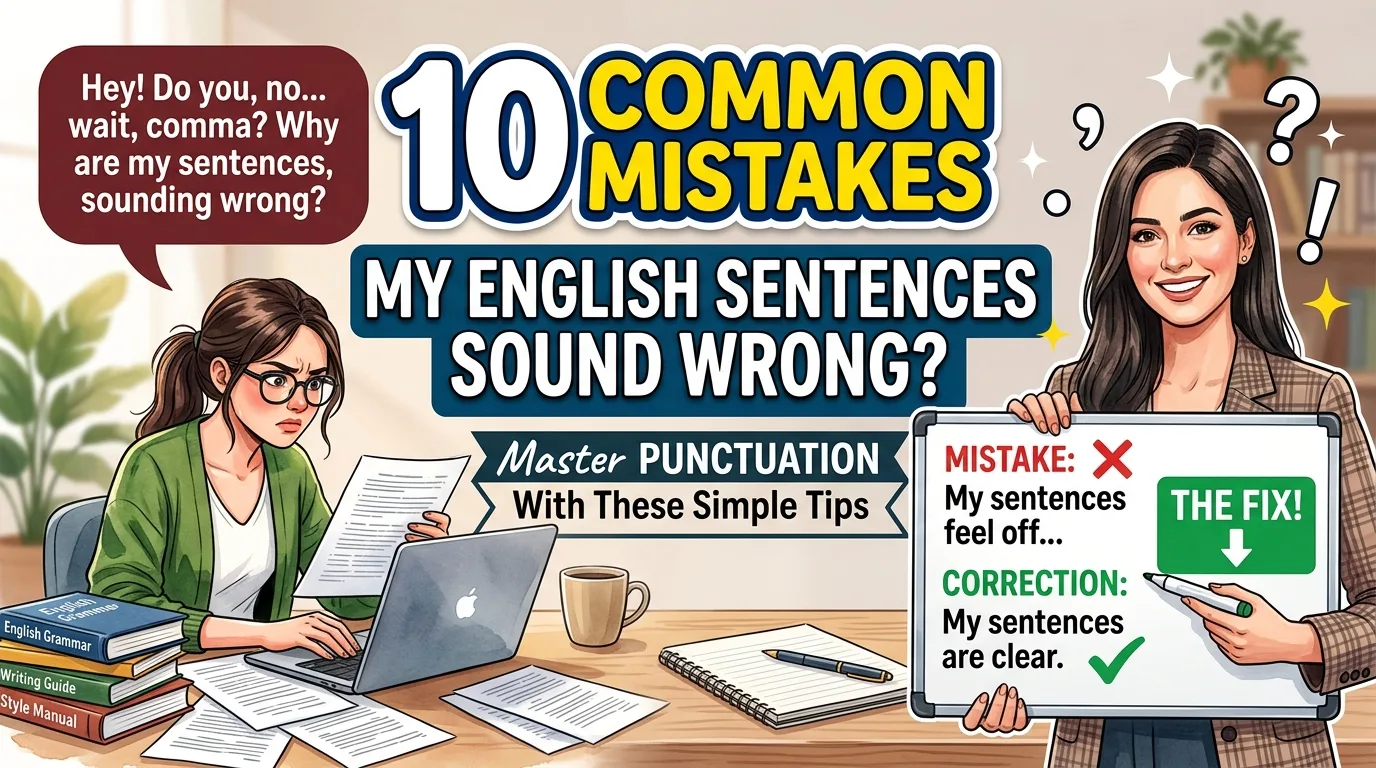
Do your English sentences sometimes sound wrong even when the grammar seems fine? The problem is often punctuation. A missing comma, a misplaced apostrophe, or a run-on sentence can confuse your reader and make your writing feel off.
The good news: punctuation follows clear rules. In this article, you will learn 10 common mistakes with punctuation, see the wrong and correct forms side by side, and practice with a quick self-check quiz. Let's make your sentences sound right.
Why Punctuation Matters
Punctuation is not decoration. It tells the reader where to pause, what belongs together, and what is extra information. Compare these two sentences:
- Let's eat Grandma.
- Let's eat, Grandma.
The comma changes the meaning completely. Small marks, big difference.
10 Common Punctuation Mistakes
1. Missing Comma After an Introductory Phrase
| Wrong | Correct | Explanation |
|---|---|---|
| After the meeting we went home. | After the meeting, we went home. | Use a comma after an introductory phrase. |
Example: Before you leave, please turn off the lights.
2. Comma Splice (Two Sentences Joined by a Comma)
| Wrong | Correct | Explanation |
|---|---|---|
| I was tired, I went to bed. | I was tired, so I went to bed. | Join two independent clauses with a conjunction or a semicolon, not just a comma. |
Example: She studied hard; she passed the exam.
3. Run-On Sentence (No Punctuation at All)
| Wrong | Correct | Explanation |
|---|---|---|
| He loves pizza he eats it every day. | He loves pizza. He eats it every day. | Separate independent clauses with a period, semicolon, or conjunction. |
Example: The rain stopped. We went outside.
4. Apostrophe Confusion: Its vs. It's
| Wrong | Correct | Explanation |
|---|---|---|
| The dog wagged it's tail. | The dog wagged its tail. | Its shows possession; it's means "it is" or "it has". |
Example: It's raining, so the cat is hiding its toys.
5. Missing Comma in a List
| Wrong | Correct | Explanation |
|---|---|---|
| I bought apples oranges and bananas. | I bought apples, oranges, and bananas. | Use commas to separate items in a list. |
Example: We need flour, sugar, and eggs.
6. Wrong Quotation Mark Placement
| Wrong | Correct | Explanation |
|---|---|---|
| She said "I am tired". | She said, "I am tired." | In American English, put commas and periods inside quotation marks. |
Example: He asked, "Are you coming?"
7. Missing Hyphen in Compound Adjectives
| Wrong | Correct | Explanation |
|---|---|---|
| a well known author | a well-known author | Use a hyphen when a compound adjective comes before a noun. |
Example: She is a ten-year-old girl.
8. Semicolon vs. Colon Mix-Up
| Wrong | Correct | Explanation |
|---|---|---|
| I need three things; milk, bread, and eggs. | I need three things: milk, bread, and eggs. | Use a colon to introduce a list; use a semicolon to join related independent clauses. |
Example: He had one goal: to win.
9. Missing Question Mark
| Wrong | Correct | Explanation |
|---|---|---|
| Where are you going. | Where are you going? | End direct questions with a question mark. |
Example: What time does the movie start?
10. Overusing Exclamation Marks
| Wrong | Correct | Explanation |
|---|---|---|
| I love it!!! It's amazing!!! | I love it! It's amazing. | Use one exclamation mark for strong emotion; too many weaken your writing. |
Example: Congratulations! You passed the test.
Quick Self-Check Quiz
Test yourself. Choose the correct sentence.
- Which is correct?
- a) After lunch we played soccer.
- b) After lunch, we played soccer.
- Which is correct?
- a) Its cold outside.
- b) It's cold outside.
- Which is correct?
- a) She said, "Hello."
- b) She said "Hello".
- Which is correct?
- a) I like tea, coffee, and juice.
- b) I like tea coffee and juice.
- Which is correct?
- a) Where is the station?
- b) Where is the station.
Answers: 1b, 2b, 3a, 4a, 5a. How did you do? Every mistake is a chance to learn.
FAQ
Q: What is the most common punctuation mistake? A: The comma splice is very common. Remember to use a conjunction or semicolon.
Q: Do I always need a comma before "and" in a list? A: In American English, the Oxford comma (before "and") is often recommended for clarity. In British English, it is optional.
Q: How can I improve my punctuation? A: Read your writing aloud. Pause where you would naturally breathe, and check if a comma or period belongs there. Practice with short sentences first.
Q: Is punctuation different in formal and informal writing? A: Yes. Informal writing (texts, social media) is more relaxed. Formal writing (essays, emails) follows stricter rules.
Q: What about math and punctuation? A: In math, punctuation still matters. For example, in ( f(x) = x^2 + 3x - 4 ), the plus and minus signs separate terms clearly. A missing sign changes the meaning.
Final Tips
- Read aloud to hear where punctuation is needed.
- Keep a cheat sheet of the rules above.
- Proofread your writing after a short break.
- Practice daily with one or two sentences.
You can master punctuation. Start with one rule today, and soon your sentences will sound right every time.