Everyday Problem Solving: From Expressing Ideas to Budgeting Life
By Mohamed IDBRAHIM - October 17, 2026 - 3 min read
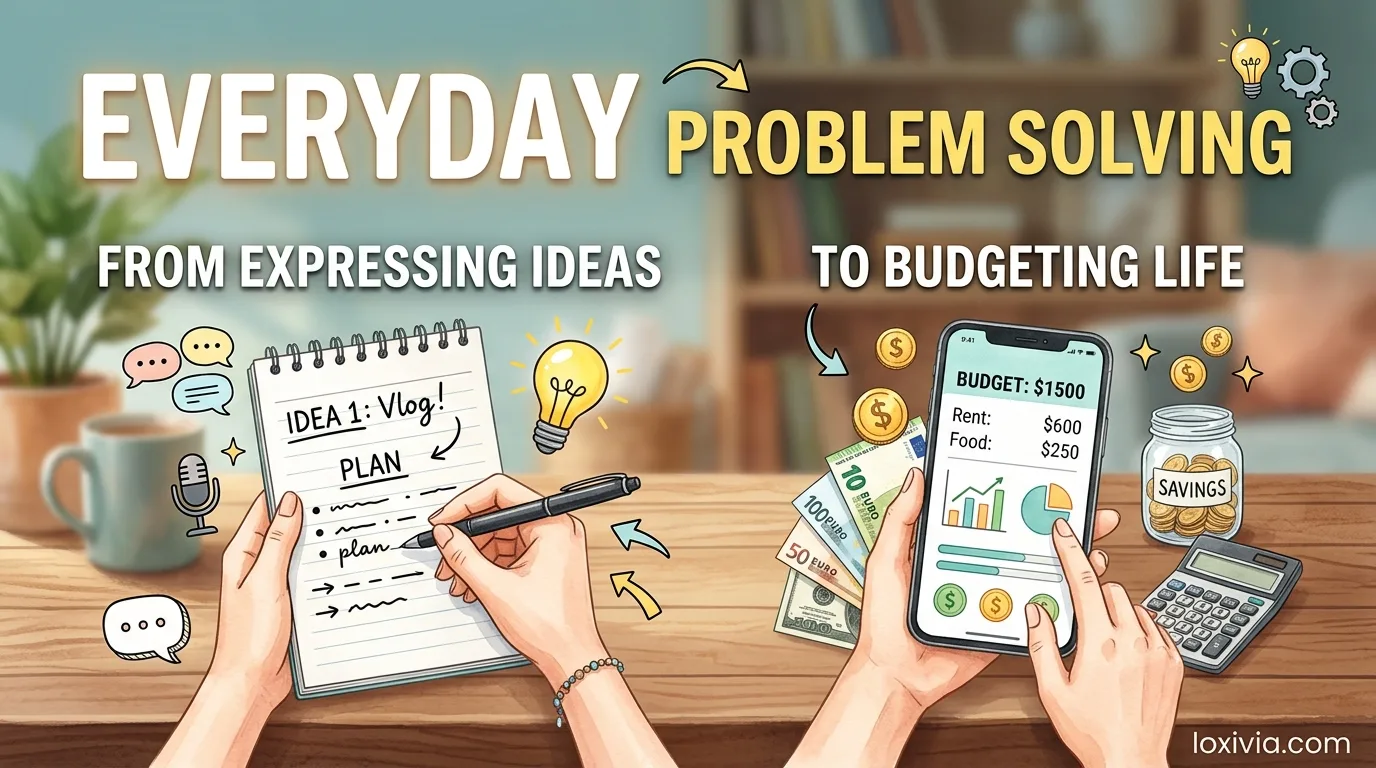
Introduction
Every day we face small problems: a broken phone, a tight budget, a missed bus. Knowing how to talk about these situations in English helps you solve them and sound natural. This article teaches you the language of everyday problem solving, from expressing ideas to budgeting your life.
Definition
Everyday problem solving is the ability to identify a daily issue, think of possible solutions, and communicate them clearly. It combines vocabulary for describing problems, suggesting solutions, and making decisions, especially about money and time.
Synonyms and Nuances
| Synonym | Nuance | Register |
|---|---|---|
| Troubleshooting | Finding and fixing specific faults, often technical | Neutral to formal |
| Resolving | Settling a problem or dispute | Formal |
| Sorting out | Dealing with a problem informally | Informal |
| Fixing | Repairing something broken | Neutral |
| Managing | Handling a situation or resources | Neutral to formal |
| Coping | Dealing with stress or difficulty | Neutral |
Collocations
| Collocation | Example |
|---|---|
| solve a problem | We need to solve this problem quickly. |
| face a challenge | Many families face a budget challenge. |
| come up with a solution | She came up with a clever solution. |
| tight budget | We are on a tight budget this month. |
| make ends meet | It is hard to make ends meet with one salary. |
| cut costs | We cut costs by cooking at home. |
| track expenses | I track my expenses with a simple app. |
| work out a plan | Let's work out a plan for the week. |
Example Sentences
- When my laptop stopped working, I troubleshot the problem and found a loose cable.
- We need to come up with a solution for our tight budget before the weekend.
- She sorted out the issue with the landlord by talking calmly.
- To make ends meet, they cut costs on entertainment and eating out.
- He tracks his expenses daily to avoid overspending.
Common Mistakes
- Using solve for people: I solved my friend is wrong. Use I helped my friend or I resolved the conflict with my friend.
- Confusing budget (noun) and budgeting (verb/noun activity). Say I am budgeting not I am budget.
- Saying make a solution instead of come up with a solution or find a solution.
- Using cope without with: I cope the stress is wrong. Say I cope with the stress.
- Forgetting that everyday is an adjective: everyday problems is correct, but I solve problems everyday is wrong; use every day as an adverb.
Word Family
| Noun | Verb | Adjective | Adverb |
|---|---|---|---|
| problem | solve | problematic | problematically |
| solution | solve | solvable | (none) |
| budget | budget | budgetary | (none) |
| expense | spend | expensive | expensively |
| challenge | challenge | challenging | challengingly |
Mini Practice Quiz
-
Complete the sentence: We need to ______ a solution for our tight budget. a) make b) come up with c) do
-
Which word means 'to deal with a problem informally'? a) troubleshoot b) sort out c) resolve
-
Correct the mistake: I cope the stress by exercising.
Answers:
- b) come up with
- b) sort out
- I cope with the stress by exercising.
FAQ
Q1: What is the difference between 'everyday' and 'every day'? A: Everyday is an adjective meaning ordinary or daily (e.g., everyday problems). Every day is an adverb phrase meaning each day (e.g., I solve problems every day).
Q2: How can I talk about budgeting in English? A: Use phrases like make a budget, track expenses, cut costs, and make ends meet. For example: I made a budget to track my expenses and cut costs.
Q3: Is 'troubleshoot' only for computers? A: No, you can troubleshoot any problem, from a car engine to a relationship. It means to find and fix the cause of a problem.